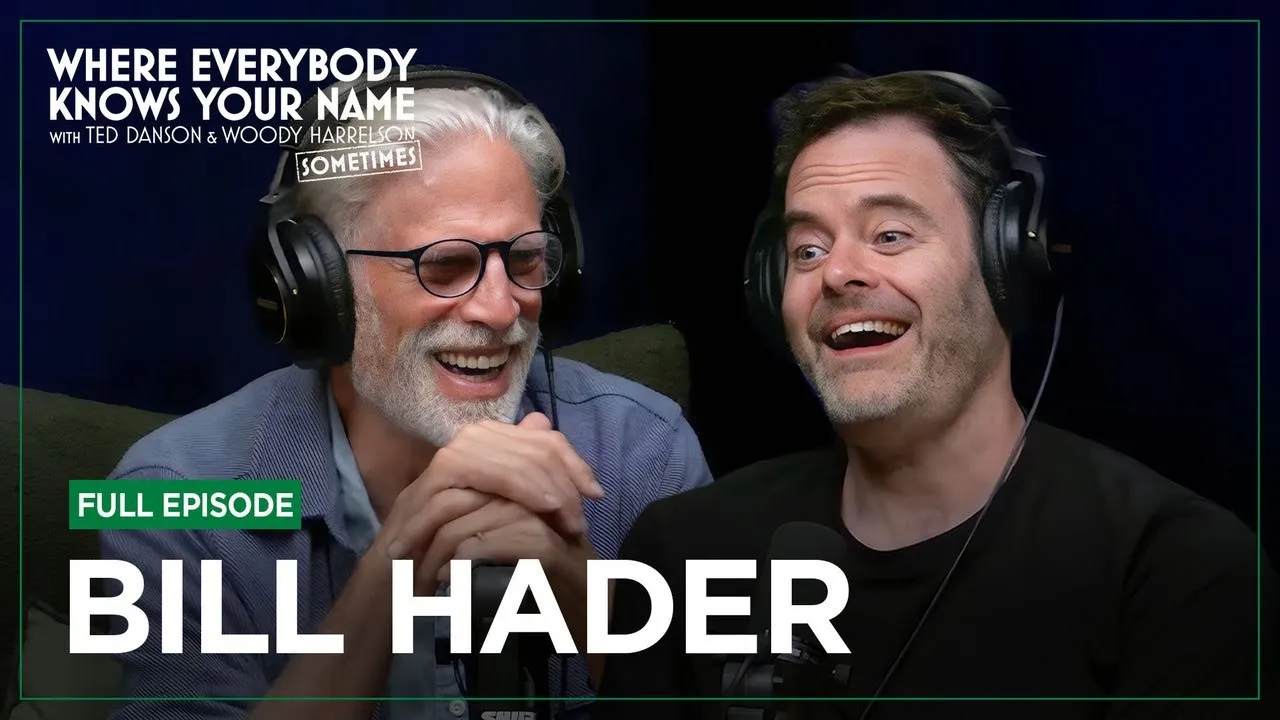
Bill Hader and Ted Danson Bond Over the One Thing Funnier People Are Supposed to Hide
Two of the most decorated comedy actors alive spend ninety minutes comparing anxiety attacks, SNL nightmares, and the specific horror of bombing in front of a Sarah Palin crowd.
Listen on YouTube · Spotify · Apple Podcasts
 WATCH NOW↓
 The bit where Bill Hader describes his laugh as a Pepsi bottle being shaken until everything gets out of your system is, accidentally, the most precise description of performer anxiety you will ever hear on a podcast. He’s not talking about stage fright in the abstract. He’s talking about sitting on a talk show, feeling it bomb, and laughing so hard he looks like he’s having the time of his life while internally screaming to abort. Ted Danson, who once took a valium before his first soap opera taping and then sprinted away from a fan for no discernible reason, understood immediately. That shared frequency is what makes this episode work. These two did not need to warm up.
You have such a great laugh and I’m like oh I’m I’m dying inside I want to be home so bad.
The show is technically a crossover, Hader guesting on Danson’s podcast Where Everybody Knows Your Name, which airs as part of the Conan O’Brien feed. The setup matters less than the result: two men who spent decades performing in front of live audiences comparing scar tissue. Hader on the Fart Face sketch, which died in dress rehearsal at the highest-rated SNL episode in history, then got bumped up to right after Weekend Update by Lorne Michaels on a night when Amy Poehler and Sarah Palin had the crowd at a fever pitch. He and Josh Brolin and Will Forte stood there backstage before going out, fully aware they were about to crater the whole thing. Brolin’s pre-show speech was five words: “Well fellas, let’s shut these up.” They did not shut them up.
The Will Forte Theorem
Forte is the ghost haunting this episode, and Hader is clearly still working out how to feel about him. The affection is total. The bafflement is also total. Hader describes Forte’s Potato Chip sketch, a baffling bit with Blake Lively about a guy trying to be an astronaut, as something he still cannot explain the origin of. The audience was “befuddled.” Forte came offstage and said it went great. This is the lesson Hader admits he learned and cannot fully replicate: making something entirely for yourself, with no antenna up for the room. The room for Forte does not exist. Hader envies this. He also clearly could not live that way for five minutes.
He doesn’t care about room there is no room he’s doing it for himself.
Danson’s SNL hosting story involves twenty-five actual pigs on stage, Mike Myers wetting his pants as part of the monologue bit, and Danson being asked at the end of the night how he liked it. His answer: “I lived.” Which tracks. He also describes his first full panic attack the night before his soap opera debut, calling a therapist who told him to take a valium, and then showing up to 30 Rock still half-sedated and running from a stranger who recognized him from a commercial. The producer’s solution was to reclassify his character from suave seducer to town sleazeball who rats out his friends to the Mafia. Adaptation.
Barry, Endings, and the Problem of Being Ted Who Works
Hader is generous about how Barry got made, giving credit to Alec Berg, to HBO’s willingness to let the hitman premise get grounded in Marine Corps reality, to casting Steven Root. But the best part of the Barry section is the simplest: he ended it because it was done. No hedging, no talk of audience demand. While writing season four over Zoom during the pandemic, everybody in the room felt it close. That’s the whole explanation. For a show that spent four seasons asking whether a person can actually change, the ending sounds like it came from the same place the show did: an instinct about what’s true, not what’s marketable.
I have so much respect for that you know you know that you don’t just keep going because it’s popular and you’re making money you tell your story and get out.
Danson closes by confessing that when he goes four or five days without working, he gets lightheaded and disoriented, loses track of who he is. Hader knows this exactly. He was texting writers from his kids’ volleyball games, his brain running Barry edits while his body sat in a bleacher. The vacation to London and Paris with girlfriend Ally McCoist, his first real one since 2008 by his own count, sounds less like a trip and more like a depressurization chamber. Both men arrive at the same place: the work is the identity, and figuring out who you are when the work stops is the actual project. For two people who built careers playing other people, that is not a small thing to sit with.

Bill Hader on Celebrity Text Chains, Van Halen Brothers, and the Oompa Loompa Union Meeting That Went Nowhere
The Barry creator stops by The Best Show to discuss fake press conferences, David Lee Roth's inexplicable EP, and a pitch to the Roald Dahl estate that died on arrival.
John Mulaney, John Mayer, Jimmy Carr, Jim Gaffigan, and Jim Downey Walk Into Conan's Podcast
Five guests, one episode, and a running lawsuit fantasy that somehow becomes the most coherent bit of the whole thing.
Mike Birbiglia and Conan O'Brien Compare Catholic Fathers, Pope Shoes, and What Kids Actually Think of Their Famous Parents
Two Worcesterites with doctor dads and a shared audience with Pope Francis spend an hour discovering they have basically lived the same life.
Will Ferrell Runs a Hamster Wheel 50 Feet in the Air and Still Had to Sing
A quarantine-era Conan interview that doubles as proof Will Ferrell genuinely cannot stop performing, even when strapped inside a steel contraption above a film set.
The circuit, read weekly. No noise.