Don Lincoln Wants You to Understand Why Time Is Weirder Than You Think
A Fermilab physicist walks Lex Fridman through the history of spacetime, and the most interesting part is what nobody actually understands.
Listen on YouTube · Spotify · Apple Podcasts
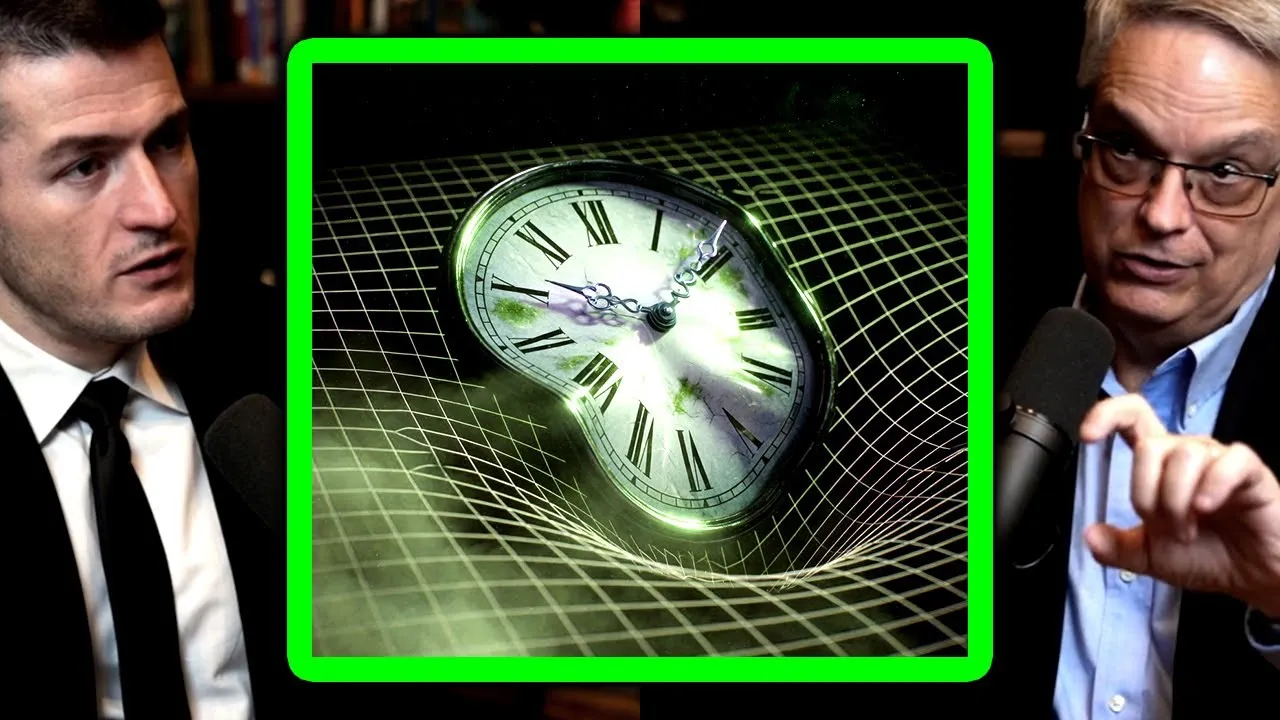 WATCH NOW↓
 Don Lincoln opens with the most quietly devastating admission in physics: we do not know what time is. Not in the way you might shrug and say nobody really knows anything. In the way that time is the single most unavoidable feature of human experience, the thing every organism on Earth is enslaved to, and physicists, who have mapped the inside of a proton and bent light around a black hole, still can’t tell you what it fundamentally is. Lincoln doesn’t linger on the embarrassment. He just says it and moves on. Which is somehow worse.
We don’t really understand what time is, which is weird. You think that that’d be something we’d understand very well, but we really don’t.
What follows is a brisk tour through the unification projects of physics, Newton to Maxwell to Einstein, with Lincoln as a genuinely good guide, the kind who makes you feel smart for following along rather than dumb for not already knowing. The Einstein section is the one to stay for. He’s careful to give credit to Hermann Minkowski, Einstein’s teacher, for the actual mathematical formulation of spacetime, a correction most pop-science tellings skip. Einstein had the physics intuition. Minkowski looked at the equations and saw that space and time were, structurally, the same kind of thing. That is either the most clarifying fact in all of science or the most unsettling one, depending on your mood.
The Speed of Light Is Not a Suggestion
Fridman asks how weird the cosmic speed limit actually is, on a full ranking of physics weirdness. Lincoln’s answer is honest and then instructive. His first reaction, he says, was that it pegged the weird meter. But then he arrived at the reframe that made it click: the speed of light isn’t the speed of light through space. It’s the speed of light through spacetime. Once you accept that space and time are unified, there has to be one speed at which things move through that unified thing. The limit isn’t arbitrary. It’s structural. That is a genuinely good explanation, the kind that doesn’t make the weirdness disappear but gives it a shape you can hold.
The speed of light. It’s the speed of light through spacetime. Once you embrace that, that makes a whole ton of sense.
He also describes the actual particle-physics experiment that proves Einstein’s second premise, that the speed of light is the same for all observers, without relying on Einstein’s authority or the general vibe of scientific consensus. Particles moving at 95 percent the speed of light decay into photons, and those photons travel at the speed of light, not at one-point-nine-five times the speed of light as Newtonian intuition would demand. The detector says what it says. Lincoln is clearly delighted by this. A working physicist who still finds the confirmation exciting is a better advertisement for physics than any explainer video.
The Aha Moment Is Not Enough
The conversation shifts to how revolutionary ideas actually get made, and Lincoln gives the most useful answer: the spark is real, but it’s insufficient. He’s clearly thought about this because he gets letters from people with intuitions and no rigor, and he has to know what to say to them. His framing is that genius is the combination of the intuitive leap and the willingness to beat your own idea to death. Einstein, he points out, couldn’t accept quantum mechanics, but he was still an invaluable critic of it, drawing out the implications of entanglement and forcing people to go test them. Being wrong about a thing while being ferociously rigorous about it is still a contribution.
It’s always depressing when I have this brilliant idea and it gets killed, but it’s better to be killed than to keep it around and waste time on it.
There’s also the Niels Bohr line that Fridman brings up, the one about an idea being crazy but maybe not crazy enough, and Lincoln endorses it with the caveat that the craziness still has to survive contact with mathematics and experiment. This is the central tension of physics right now: the next unification, whatever ties together quantum mechanics and general relativity, will almost certainly require a leap that looks insane from inside current frameworks. Lincoln doesn’t pretend to know what that leap is. He just makes a convincing case that whoever makes it will need both the spark and the discipline. The spark alone gets you a letter to a physicist’s inbox.
Don Lincoln Has Spent 30 Years Looking for Dark Matter and Has Absolutely No Idea What It Is
The Fermilab physicist makes a compelling case for something he cannot find, cannot name, and cannot stop thinking about.
Don Lincoln says we exist because the early universe had one extra matter particle per billion antimatter particles
The Fermilab physicist framed existence as the leftover scrap from a cosmic matter-antimatter wipeout, then admitted nobody knows what caused the imbalance.
Don Lincoln says quantum field theory predicts dark energy 10^120 times too large
The Fermilab physicist puts a number on the vacuum catastrophe, and the number is so stupidly large it makes ordinary scientific failure look dainty.

Anthony Kaldellis says Byzantine Greek fire came in hand grenade form
The historian’s best detail on Lex Fridman was not just that Greek fire burned on water, but that the Romans apparently bottled the stuff and threw it at siege engines.
The circuit, read weekly. No noise.